Showing posts with label Taiwan. Show all posts

Wednesday, August 5, 2015

Typhoon Matmo in Taiwan, July 23, 2014


With Super Typhoon Soudelor set to hit Taiwan this Friday, I thought it is a good time to show the power of Typhoon Matmo from July 2014.

Stock Footage of Typhoon Matmo in Taiwan

 
Typhoon Matmo made landfall in Taiwan at midnight local time, July 23, 2014. It brought severe winds and torrential rain to Taiwan. At least 10 people were injured. It washed out one bridge, and disrupted electricity in Hualien on the east of Taiwan, but it did not cause much other damage.

Typhoon Matmo in Taiwan


Matmo made landfall with winds of over 160 km/h. The heaviest rain the typhoon brought was across the higher terrain of the east and interior Taiwan, dumping 650 millimeters of rain in the mountainous areas in the eastern coastal counties of Taitung and Hualien. Taipei had rainfall of 50–100 mm with wind gusts close to 100 km/h.

HD Stock Footage of Typhoon Matmo in Taiwan


Thursday, May 21, 2015

Beauty Shoot with Taiwanese Model

Asian beauty applying cream to face
Taiwanese woman applying cream to face, beauty shot
© Photographer: Kenneth Paul | Agency: Dreamstime.com
I was organizing a beauty shoot a few weeks ago. The ideas about beauty in Asia are different to those in the West. In brief (I will do a more in-depth post about this soon), Chinese woman prefer whiter looking skin, bigger eyes, and less accentuated facial features (So less contouring and highlighting to get a flatter appearance).
Asian beauty portrait
Chinese woman beauty shoot
© Photographer: Kenneth Paul | Agency: Dreamstime.com
The tendency towards whiter paler skin comes from stereotypes about social status; darker skinned people are seen as sun-baked laborers who work in the fields. This is quite different from the Western perception of paler people being unhealthy or ill. To exaggerate this look, beauty photos in Taiwan are often slightly overexposed to wash out more detail. In addition the model would wear foundation that is perhaps a shade or two lighter than her actual skin tone to get a brighter complexion.
Asian beauty portrait
Taiwanese woman beauty
© Photographer: Kenneth Paul | Agency: Dreamstime.com
Overall, the standard of beauty in Western countries generally veers toward a mature, seductive, sexy, and sultry look while in Asia, especially Taiwan, China, and Japan, the standard of beauty reflects youth, innocence, purity, and cuteness. With this in mind, I cast a model who embodied all of these traits perfectly.
Portrait of Chinese woman clear skin
Chinese woman modeling for beauty shoot
© Photographer: Kenneth Paul | Agency: Dreamstime.com
All the photos were shot on a Canon 6D with a Canon 70-200 F2.8 L lens. The lighting was a standard beauty lighting clamshell setup for most of the shots. The key light was a monolight in an 80 cm brolly box on top with a reflector at the bottom. Two V-flats were used in front and two monolights used on the white background. The key light was placed relatively low for less contrasty, flatter look. The two white V-flats in front were also added to reduce shadows. Two black V-flats were put on the sides to add definition to the outline of the face.
Asian female applying mascara
Chinese woman applying mascara for beauty shoot
© Photographer: Kenneth Paul | Agency: Dreamstime.com

For more photos from this series and others, see this set:
shutterstock asian beauty skincare chinese taiwanese

Thursday, March 26, 2015

Lehua Night Market in Yonghe, New Taipei City (Chinese: 樂華夜市; pinyin: Lèhuá Yèshì)


Compilation of clips of Lehua Night Market in New Taipei City, Taiwan from Images By Kenny on Vimeo.


I've been living in the Yonghe District, New Taipei City for about eight of my nine years in Taiwan. One of the best places to go around Yonghe is the Lehua Night Market.


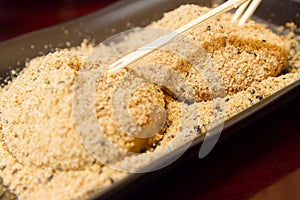
The 30-year-old night market has a great mix of everything from food to clothes. The awesome and interesting street food at vendors here includes fried chicken steaks, oyster omelets, tempura, mochi, almond tofu, almond milk, shaved ice, and rice cakes. A relatively new addition here is the beef cubes cooked with a blowtorch, which is apparently a Taiwanese traditional food (well, as traditional as anything involving a blowtorch can be). As with most night markets, the vendors prepare the food right in front of you.

Hakka mochi in Taiwan
Taiwanese Hakka mochi dessert

© Photographer: Imagesbykenny | Agency: Dreamstime.com

If you not into street food, there are also many restaurants, including good pasta and steak restaurants. On a side note, a night market is not a place you'd usually go to eat steak (Although the one in the night market is one of the best in Yonghe), but if you do want to, I suggest going to the actual steak restaurant instead of eating steak at the NT$100-steak night market stands; unless you really like inedible sinew.


Besides the snacks and street food, there are also many clothes shops, small arcades, and grocery stores, as well as seemingly out of place convenience stores and retail chain stores.


The market is pretty packed over weekends, but not quite as much as Shida, Raohe, or Shilin. Most of the stores and stalls are open from 4 p.m. to 1 a.m. There is a Party World KTV right next to it if you want to stay out after your visit.


The night market is easy to get to.

By MRT: Go to Dingxi MRT Station, go out exit 1, turn left and walk down Yonghe Road, and you will see the Lehua night market entrance. It's about a five minute walk.

By bus: Buses 5, 57, 214, 227, 250, and 304 all stop at the Party World KTV next to the night market. Buses 706, 297, 249, 262, 624, and 670 all stop at bus stops close by.

Address: YǒngPíng Rd, Yonghe District, New Taipei City, Taiwan 234
 
Have you ever been to Lehua Night Market? Tell me about your experience there in the comments below.


Shutterstock Lightbox for stock photos of Taiwanese night markets


To learn more about interesting places and sights to visit in Taiwan, check out my list of Places to see in Taiwan

Tuesday, December 30, 2014

Traditional Markets in Taiwan

Traditional market in New Taipei City
Woman selling water chestnuts at a traditional market in New Taipei City
© Photographer: Kenneth Paul | Agency: Dreamstime.com

Taiwan is known mostly for its night markets, but there is another kind of market here that deserves a visit—the traditional market (or "day market") which is open from early morning until mid afternoon and sells almost completely different products to night markets.


Traditional market in New Taipei City
Fruit and vegetable store at a traditional market in New Taipei City
© Photographer: Kenneth Paul | Agency: Dreamstime.com
 
The products at traditional markets are mostly fresh produce along with some street food and snacks. Although the target market for these traditional markets is mainly housewives and people shopping to cook at home, they make for an interesting excursion to experience the charm and diversity of Taiwan.
Traditional market in New Taipei City
Fresh meat at a vendor at a traditional market in New Taipei City
© Photographer: Kenneth Paul | Agency: Dreamstime.com
 
Just like the night markets, they are made up mainly of street vendors, although some stores do form an integral part of some of them. About seventy to eighty percent of the vendors sell fresh fruit and vegetables; others sell fresh meat and fish, while the rest sell street food like fried chicken, tofu, and water chestnuts.
 
Traditional market in New Taipei City
Fresh vegetables at a vendor at a traditional market in New Taipei City
© Photographer: Kenneth Paul | Agency: Dreamstime.com

The fruit and vegetables at traditional markets are usually quite a bit cheaper than conventional stores or supermarkets as well as being fresher.
 
Traditional market in New Taipei City
Fresh meat at a vendor at a traditional market in New Taipei City
© Photographer: Kenneth Paul | Agency: Dreamstime.com


If you get the chance, go and take a stroll through one of these and see a side of Taiwan many tourists miss.
If you need help finding a traditional market on your trip, drop me a comment below, and I'll help you find one.

Traditional market in New Taipei City
Woman buying street food from a vendor at a traditional market
© Photographer: Kenneth Paul | Agency: Dreamstime.com
 
More of my photos of traditional and night markets in Taiwan can be found here:
Stock photos of traditional and night markets in Taiwan

To learn more about interesting places and sights to visit in Taiwan, check out my list of Places to see in Taiwan


Thursday, June 5, 2014

Shooting for Haxstrong T-shirt Catalog


The lovely Schoombee family posing for Haxstrong shoot

My friend Gregg Haxton is an overall all-round awesome person. A few years ago he was in a terrible motorcycle accident and landed up in a coma for two months and losing one of his eyes. He made a tremendous recovery despite of his physical injuries and partial brain damage. He fought his way back to health from a condition where many people would have given up all hope. He is a truly inspiring man.

Mei posing for clothing catalog shoot
These days, Gregg still has not fully recovered from some of the injuries, but has a whole new outlook of life. He now runs Haxstrong, a charity that helps people who are in need of medical care both with financial and moral support.
Add caption

Due to me living in a different city I'm not able to volunteer with Haxstrong's everyday operations. So I was delighted when I got a chance to help out by shooting some catalog photos for the T-shirt range they produce to raise funds. These have been used in flyers and posters so far but we should be working on the full catalog soon. Some of the models I work with on a frequent basis and friends were kind enough to support the shoots by modeling pro bono for the shoots.
Bean striking a pose for clothing catalog shoot
 For more information about Haxstrong, visit the website at http://haxstrong.org/ or the Facebook page at https://www.facebook.com/Haxstrong

Thursday, May 15, 2014

The Taiwan Confucian Temple


The Taiwan Confucian Temple (台灣孔廟; also called Tainan Confucian Temple, 台南孔廟 or 台南孔子廟)
 
I've been to Tainan a few times and every time I go there I visit the Taiwan Confucian Temple. The temple is not highly decorated temple like the more ornate temples I have seen around Taiwan, but it has a wonderful calming atmosphere which exudes the grace of traditional Chinese culture.

Bonsai trees in row outside temple
© Photographer: Imagesbykenny | Agency: Dreamstime.com
 
I was in Tainan again a few weeks ago while working with a film crew on a short film. I didn't think there would be time to go sightseeing due to the deadlines we had. But we had an unforeseen break in the shooting schedule right in the middle of the afternoon and it turned out the shoot location was two blocks away from the temple.

Row of bonsai trees  outside temple
© Photographer: Imagesbykenny | Agency: Dreamstime.com
 
The Tainan Confucius Temple was built in 1665 by Zheng Chenggong as a school for teachers to offer lecture and cultivate intellectuals. It is one of the most historically important buildings in Taiwan, as it is one of the oldest buildings and Taiwan's first official school. These days, the temple preserves ancient Confucian ceremonies and is a popular as a tourist attraction and a park where the locals like to relax.

Wall of Chinese Style House
© Photographer: Imagesbykenny | Agency: Dreamstime.com
 
In the middle is the Dacheng Hall with a double-eave round hip roof. It is surrounded by an enclosure of halls. In front there is the Dacheng Gate and the main courtyard. There are also two ceremonial gates—the Li Gate and the Yi Path—which symbolize the main disciplines of Confucianism.  Next to Dacheng Hall is the Hall of Edification, where you can see beautiful calligraphy. In the corner behind the Minglun Hall is the Wen Chang Pavilion, a three story pavilion dedicated to the literature deity, Wen Chang. The area is surrounded by big red walls with two gates allowing access—the East Dacheng Gate on Nanmen Road and West Dacheng Gate.

Wall of Chinese Style House
© Photographer: Imagesbykenny | Agency: Dreamstime.com
 

Across Nanmen Road is the Pan Gao Stone Arch, which leads into a pedestrian street with lots of vendors and small restaurants. This is defiantly the place to go for lunch if you take a trip to the temple. There are also many other sites within walking distance.


The official website for the temple is http://confucius.culture.tw/

To learn more about interesting places and sights to visit in Taiwan, check out my list of Places to see in Taiwan

Sunday, April 13, 2014

Examples of My Workflow with Actor Headshots

Headshot shoot for an actor in Taipei

 Headshot sessions can be done in the studio or on location. Personally, I prefer location shoots for corporate headshots to give them an environmental portrait look. But I prefer studio shoots for actor headshots so the focus is 100% on the face, without any distracting background elements.  


I emphasize that headshots should be fun! We are trying to capture a range of images that show your personality. There is no need for modesty, at the shoot you are the center of attention. You can relax, emote, play, goof off, and be free to step out of your comfort zone.

Setting up for the headshot session

I always set up the lighting and test exposures with a gray card before the actor arrives. Having people wait to be photographed while you set up lights sometimes makes the subject nervous, impatient, or fidgety; none of these are good for the shoot.

For actor headshots I keep the light soft and even. Dramatic lighting is great for portraits but casting directors want to see faces not lighting. I position the key light in a brolly box or shoot through umbrella slightly off center to the actor's head to keep the lighting even but still retain definition. I use a white or silver reflector as a fill; usually just below chest height. I keep both of these light sources as close as possible to the actor's face for soft flattering light.

There are two strobes with modifiers lighting the white background with black V-flats stopping direct light from these hitting the subject and white V-flats on each side of the actor to keep the lighting even around the face.

For headshots, I use a Canon 70-200 f2.8 L telephoto lens which compresses the distance to the subject and is more flattering to facial features.

Posing for head shot in photoshoot


The headshot shoot

Getting a good headshot goes beyond technical ability. The most important element to me is understanding my subject, the roles and characters they play, and their expectations of the picture. So before the session, I'll discuss the goals of the headshot with the talent to get an idea of the style required.

JJ is a Belgian-Chinese actor, animator, and martial artist. He has acted in several short films in Taiwan. He tends to play the villain role, so we went for more ominous-looking headshots to show off his bad ass side. I usually suggest sticking to head and shoulder shots for actor's portfolios as this is what casting directors want to see. In JJ's case, he also wanted to show his martial artist side, so we included a few shots to show these poses along with the appropriate clothing. JJ also wanted to have shots with and without facial hair, so we shot the first half with facial hair, then he shaved and we took more shots of his clean-shaven look.

Adding in some drama to show acting talent


Brandon is an American actor, comedian, and singer with a big warm personality. To me, Brandon looks like a young Mickey Rourke. His experience on stage showed as he was automatically at ease in front of the camera. This comfort, confidence, and relaxed attitude translates well on camera and greatly improves the quality of the headshots.

Brandon mostly wanted to show his potential as a comedian. We went with suits for clothing to give a polished professional look, but kept most of the poses fun and whimsical to show off his comedic expressiveness.    

Brandon, an actor in Taiwan in headshot session

Proofing Gallery for the Headshots

The headshot shoot is the fun part of having new headshots taken. The difficult (and most difficult part) is choosing the right images from the online proofing gallery. It's important to choose the ones that represent you as an actor. I suggest asking advice from friends and family when picking these to get an idea of how others see the "real" you. Below is an example of a proofing gallery from JJ's shoot.

Proofing gallery for headshots

Retouching Headshots

Headshots for actors are meant to represent what you look like in person. So I do not do high-end fashion style retouching. I first remove temporary imperfections, such as redness in the eyes, blemishes, stray hairs, etc. Then I soften dark shadows, complexions, and wrinkles and bring out features like the eyes, but I do not remove permanent facial features like moles and scars. 

 If you are an actor in Taiwan, and looking for a headshot, check out my headshot packages for actors.


Sunday, February 2, 2014

I Spin You Right Round 101. Right Round! — Hyperlapse of Taipei 101


After seeing the hyperlapse of CN Tower, I thought it would be a good idea to try that with Taipei 101, the second tallest building in the world. Shooting this with a square building proved to be a bit moredifficult than I realized.


I started of by using FreeMap Tools to draw a radius around Taipei 101. Then I checked the points
around the radius on Google Maps to see which points had a clear view of
Taipei.


When I actually started shooting the points on the map turned out to have different perspectives, so I suspect that the radius tool may not have taken it from the exact center of the building. So I ended up going thepoints and judging by flipping through the pictures to check. There were some points where there were too many buildings at street level to shoot from, so I changed the perspective slightly.


Even though I had aligned the images to a grid while shooting, they were not perfectly matched, so I auto-aligned the images in Photoshop. This still didn't align 100%. So I did more manual alignment by drawing a straight line from the tip of 101 on a new layer, changing the opacity of that layer to 50% and then lining up each individual photo.


After all the alignments, all the photos needed to be recropped. Finally I added some blur on the foreground elements to add to the spinning motion. Thanks to Candy Glass Productions for the invaluable tips!


Saturday, December 28, 2013

The 13 Levels (Shuinandong Smelter)


 After several trips to the Jinguashi area, I finally got around to the 13 Levels. Two other photographers and I went to explore the ruins last Sunday. Jinguashi and Jiufen are full of artifacts and buildings from their mining era, but the Shuinandong Smelter (水湳洞精鍊廠), or 13 Levels (十三層), is one that cannot be missed; it stands on the side of the mountain overlooking the ocean looking like a dystopian fortress of sorts. Its tiered layout is the reason for the name, 13 Levels, even though there is apparently a total of 18 levels.

The 13 Levels was built for refining gold and copper ore during the Japanese Colonial Era.  It was also called the Mine Selection Plant as it was also used in the screening and selection process for high quality ores.  The various levels were for different filtration layers needed for sorting the precious metals from the normal rocks.

Abandoned warehouse
© Photographer: Imagesbykenny | Agency: Dreamstime.com
 
Due to gold and copper deposits drying up, mining in this area was no longer economically feasible. Over time this area became popular for tourists. I've written about this in earlier posts on Jinguashi and Jiufen.


Due to the high toxicity of copper refining, Shuinandong Smelter also had one of the world's longest concrete pipeline ventilation systems to carry harmful gases over the mountains without harming the nearby inhabited areas and flora.

Blue steel pillar inside abandoned warehouse
© Photographer: Imagesbykenny | Agency: Dreamstime.com
 
 
The 13 Levels are a perfect monument to how prosperity can falter rapidly.

Abandoned building
© Photographer: Kenneth Paul | Agency: Dreamstime.com


To learn more about interesting places and sights to visit in Taiwan, check out my list of Places to see in Taiwan

Monday, November 25, 2013

Jinguashi

I went to Jinguashi just a few months ago, but I decided it was worth visiting again to see the golden waterfalls I had missed on my last trip.

Jinguashi (金瓜石) is a quaint mountain town in the Ruifang District, New Taipei City, Taiwan. It is known for it's historic gold and copper mines. It is situated on Keelung Mountain (基隆山).  right next to the coastline, which makes for exquisite views. It is known as Kinkaseki in Japanese from the period when it was under Japanese control. It was used as a POW camp from 1942 to 1945.

Arrangement of houses in Jinguashi. The Cyuanji Temple with the Guan gong deity on top is in the top right side
I took the Yilan express train to Ruifang (Taipei Padu- Rueifang- Ilan- Suao). The last time I was here with Andy, we took a taxi to Jinguashi, which costs about NT$240. This time I opted for the bus (On these busy narrow mountain roads, taking a taxi doesn't seem to be any faster).  To get to the bus stop, walk out of the station, cross the pavilion, and cross the road. There is a bus stop there. The bus does not stop here on weekends, so if you are there over a weekend, turn left and continue walking to the next bus stop. The sign on the bus will say "Jinguashi (金瓜石)."  There are also buses from both Taipei and Keelung which go to Jinguashi and Jiufen.  I took the bus all the way from Taipei a few years ago on a trip to Jiufen. It was a crazy ride, and I wouldn't recommend this to people with weak stomachs. If you dare, you can go to bus stop by Zhongxiao-Fuxing MRT station, exit 1. The bus will be from the Keelung Bus Company and say "Jinguashi (金瓜石)."

Gold Ecological Park (黃金博物館區)

The bus stops right by the Gold Ecological Park, which is the main attraction for visitors here. The small park preserves and reproduces the town's mining heritage to recreate the atmosphere of 1930s Taiwan. It includes a gold museum and a number of renovated residences from the Japanese Colonial Era. The excellent translations around the park and incredibly helpful information centre make for an extremely tourist-friendly destination.

Entrance to Benshan Tunnel

The first building on the route is the Japanese ‘Four-Joined’ Style Residence, an old typical Japanese-style Residence from when Taiwan was still a Japanese colony. I hear it is interesting inside, but I gave it a miss as there was a long queue outside both times I walked past, and there were many other things I wanted to see.

Further along the route is the Crown Prince Chalet, another traditional Japanese style house once occupied by Emperor Hirohito. The interior of this house is off-limits, but the beautiful garden complete with a small golf course and archery range is worth seeing.

The Museum of Gold (黃金館) is in the former offices of the Taiwan Metal Mining Corporation. The first floor contains numerous artifacts from the town's mining history, including tools, mining transport systems, and cultural artifacts. On the second floor of the Gold Museum you can see various products made of gold and the world's largest gold brick. You can even touch this 220 kilogram pure gold brick!

The Benshan Fifth Tunnel (本山五坑),  is an abandoned mine next to the Gold Museum.  It is an interesting place to learn more about the daily activities of miners. There is a $NT50 entrance fee. Benshan used to be called "Dajingua" (大金瓜), which means "big pumpkin" in Chinese. The discovery of gold here was the catalyst for the prosperous development of Jiufen and Jinguashi. The tunnel is a real life example of what it was like to work below ground.

The area outside the Geological Park is also visitor-friendly, with many scenic walkways, trails for mountain climbing, as well pagodas and benches to take a rest and enjoy the view.

Cyuanji Temple

The Cyuanji Temple was built in 1896. It boasts having the largest statue of Guan Gong (關公)—the God of War—in the world on its roof. The gold and bronze Guan Gong statue weighs more than 25 tons.  

Some of the pagodas offer a wonderful view of the bay below. You can also see the Ying-yang sea.  This is a strange sight  where the sea is a mix of yellow and blue.  It was believed that the sea color was the result of smelting activities from Taiwan Metal Mining Corp. But, the company stopped activity there over 10 years ago and the Yin-yang Sea is still there. Scholars say that the land in Jinguashi has a large amount of pyrite that has formed Fe3+ which does not dissolve easily in water. This forms iron ion particles which float into the sea.


Souvenir steel lunchbox from one of the diners at the Geological Park

After walking around the park, I took a bus down to the Gold waterfall. The waterfall on the golden earth is one of the sources of the Ying-yang sea.  The heavy rain seeps into the mine shafts through cracks in the rocks, and reacts with the pyrite and energite underground, undergoing oxidation reduction to become acidulous water. It is a spectacular sight. It's best to see it after heavy rains for the full effect.

Golden waterfall on a mountain
Gold Waterfall at Jinguashi
© Photographer: Imagesbykenny | Agency: Dreamstime.com
 

There are a few other sights around Jinguashi that should be seen. I will return again soon to take photos of these other places. If you decide to take a trip here, don't forget to just spend some time walking around the mountain paths and trails.

For more information about the Gold Ecological Park, visit their website: www.gep.tpc.gov.tw

To see more photos from around Taiwan, visit my website: http://imagesbykenny.com/